
There’s a direction I keep coming back to at the moment, not in a “what should I do next?” way, more in a “this has always been there, I’m just now saying it out loud” kind of way. For years, I’ve been drawn to how things work in the real world, not just products on screens, but environments where people, pressure, movement and time all collide, places where things either flow really well or completely fall apart under pressure.
Early in my career, I worked on exhibition and retail experiences with brands like Dolby, Dyson and WH Smith. And even on large scale venues like Efteling Theme Parks. What always fascinated me wasn’t just digital interface design, it was how everything connected, how people moved through a space, what they noticed, what they ignored, and where things started to break
That curiosity hasn’t gone anywhere, if anything it’s louder now than it’s ever been, because I keep seeing the same patterns playing out wherever I go
When I walk through airports, stadiums, museums, or any large public venue, I notice it straight away, there’s a lot of technology, a lot of effort, and clearly a lot of investment, but there’s still friction in all the places that actually matter.
Self-service kiosks that feel stressful to use when you’re under pressure, queues that shouldn’t exist but somehow still do, moments that should feel seamless but instead feel clunky and slightly chaotic.
And it’s not because people aren’t trying, it’s not a lack of effort and it’s definitely not a lack of smart people, it’s because most of these environments are built and improved in parts, not as connected systems.
Where I’m Heading
As I shape what comes next, this is something I want to explore properly through the lab, not as a theory piece or something that lives in a slide deck, but by getting closer to real environments and understanding how they actually work
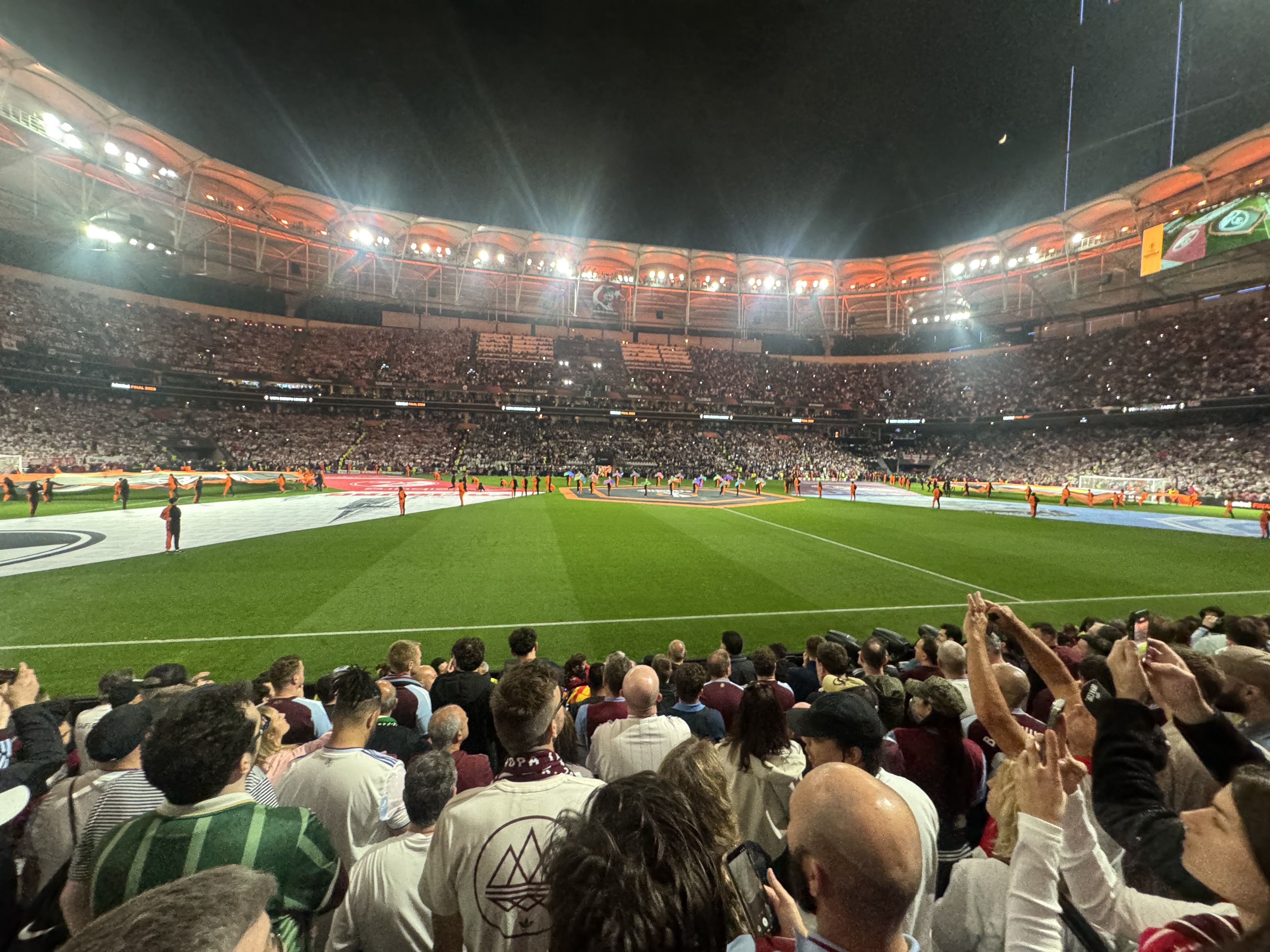
I’m fascinated by how systems design applies in places like Ashton Gate, Villa Park, and large-scale venues like the upcoming Bristol music arena. The featured image above, taken during my recent Europa League final trip with Lucas (Up The Villa!), is a good reminder of why these environments are so interesting. You’ve got thousands of people moving at once, emotions running high, time pressure everywhere, and small inefficiencies quickly becoming visible at scale.
Even on that trip, despite the huge police presence and operational planning, parts of the customer experience still felt compromised. They weren't even selling match day programmes, much to my disappointment. Small detail maybe, but it all feeds into the wider experience.
That’s what makes venues and live events such powerful testbeds, not just for improving experience, but for understanding how better systems can drive real commercial outcomes too.
The Pattern I Keep Seeing
Whether it’s a stadium, an airport or a logistics hub, the same issue keeps showing up, things are improved in isolation, usually with the best of intentions, but the system as a whole is rarely stepped back and redesigned.
A department identifies a problem, a budget gets allocated, a solution gets scoped, and something gets delivered, it ticks the box, shows progress, and moves things forward in that specific area.
But zoom out and the overall experience hasn’t really changed, it might even have shifted the problem somewhere else, which is why despite all the investment things still feel a bit broken.
Stop Optimising the Queue. Start Designing the System.
Most large organisations don’t actually have a technology problem, they have a systems problem, and it shows up in slightly different ways depending on the industry.
Airports optimise baggage, stadiums optimise hospitality, logistics firms optimise warehouses. Each department improves its bit, each team spends its budget and delivers something measurable, and everyone feels like progress has been made. And yet passengers are still stressed, fans are still queueing in the rain, and trucks are still waiting outside distribution centres. Because no one redesigned the system
The Department Trap
This isn’t about people getting it wrong, it’s about how organisations are set up to work, and once you see it you can’t really unsee it.
Budgets sit in departments, KPIs are local, procurement is often vendor-led, and innovation gets scoped narrowly, so accountability tends to stop at the edge of each team’s remit. So what you get is incremental upgrades, not systemic change, and those two things are very different. You improve the baggage carousel without touching gate timing, you add bar staff without understanding crowd movement, you install warehouse robotics without integrating upstream demand. It looks like progress on paper, but it isn’t transformation in reality.
Stadiums: The Hospitality Illusion
Stadiums see queues, especially around food and drink, so hospitality teams respond in the most logical way they can, they add kiosks, add staff, and upgrade payment systems. All useful, but still incremental. If you step back slightly the questions change, when are people arriving and what influences that, what’s the point at which someone gives up on a queue, could ordering start before they even get to the ground. Could congestion be predicted ahead of time, could behaviour be nudged in a way that improves flow, could the entire experience be designed rather than just reacted to.
Now it’s not a bar problem, it’s a system made up of behaviour, data, movement and revenue, and those things need to be designed together. Queues aren’t just operational friction, they’re lost revenue and a worse experience, and occasionally wet trainers and mild regret.
Airports: The Baggage Illusion
Airports invest heavily in improving baggage systems, smarter conveyors, better tracking, faster unloading, all of it makes sense when you look at that problem in isolation. But baggage is connected to everything around it, security flow, boarding efficiency, retail dwell time, passenger anxiety, even how people leave the airport, it’s not a standalone system. If bags arrive ten minutes earlier but security is still chaotic, the experience hasn’t improved, but if passengers move calmly and predictably everything improves, retail goes up, stress goes down, and operations become smoother.
Baggage isn’t a baggage problem, it’s a system problem.
Museums & Immersive Experiences
Museums and immersive experiences like Harry Potter Studio Tour and We The Curious in Bristol often focus on managing capacity, timed entry slots, ticketing systems, and crowd control. It makes sense, on paper it’s about throughput, getting people in and through without bottlenecks.
But the experience isn’t defined by entry times, it’s shaped by how people move, pause, engage, and feel along the way.
You can stagger arrivals perfectly and still end up with congestion around key moments, iconic exhibits, interactive spaces, photo spots. People don’t move evenly, they cluster around what matters to them. They slow down where there’s meaning, and rush through what feels like filler.
So the real question isn’t just how many people are inside, it’s how attention flows. So, could key moments be distributed more deliberately, could anticipation be built before high-demand areas, could alternative paths reduce pressure without breaking the narrative, could digital layers guide behaviour subtly without feeling controlled.
If you optimise entry but ignore how people actually experience the space, you haven’t solved the problem.
It’s not a capacity problem, it’s a flow, attention, and narrative design problem.
Logistics: The Warehouse Illusion
I had a conversation last year with one of the world’s largest logistics companies, and their focus was very clear, robotics, computer vision, AI-driven picking. All impressive, and all valuable in the right context.
But the bigger questions sit around it, what informs inbound timing, how are suppliers integrated upstream, can routing adapt to congestion in real time. Is demand forecasting connected to automation logic, are customers incentivised to help smooth demand patterns, is the warehouse reacting or is the system anticipating.
If picking becomes faster but trucks are still queueing outside, the system hasn’t improved, you’ve just made one part of it better while the overall experience is still inefficient.
The Missing Layer: Behavioural Design
This is the bit that’s often overlooked, the best systems don’t just optimise operations, they bring the customer into the system itself.
Think about Uber, it works because it’s not just infrastructure, it’s behaviour, timing, feedback and decision-making all connected. Riders aren’t external to the system, drivers aren’t external either, they are the system. And the interactions are simple, small nudges, quick decisions, very low friction, often just a yes or no.
What This Looks Like
Now imagine a stadium designed like that, not just as a place with systems, but as a connected system that adapts in real time. You get a nudge suggesting when to arrive, you can pre-order drinks with one tap, collection points adjust based on congestion. Incentives encourage better timing, staffing adapts behind the scenes, and the whole thing starts to feel smoother without you really noticing why.
It doesn’t feel like effort, it just feels like it works, and that’s usually the sign of a well-designed system. Everyone benefits, better flow, higher spend, less waste, happier people, and fewer queues in the rain.
This Is a Brand Play
None of this works without trust, people won’t engage with it unless it feels simple, fair and genuinely useful, and that comes down to brand as much as it does technology.
Brand isn’t just what you say, it’s what enables people to say yes, it’s what makes the system feel like it’s working for them, not on them. Without trust nudges feel intrusive, with trust they feel helpful, and that’s a big difference. Behaviour becomes part of the infrastructure, and brand is what makes that possible.
The Real Shift
Ten years ago this kind of thinking was harder to execute, the tooling wasn’t there in the same way and the cost of experimentation was much higher. Now most of the pieces exist, APIs, cloud infrastructure, real-time data, rapid prototyping, you can test and learn far more quickly than before
So the barrier isn’t really technology anymore, it’s how we think about the problem and whether we’re willing to step back far enough to see the whole system. Most organisations optimise departments, very few design systems, and that gap is where the opportunity sits.
The Bottom Line
My last trip to Heathrow made me stop and think... we don’t need smarter kiosks, we need smarter systems, and more importantly we need to design them properly. The future of stadiums, airports, museums and logistics won’t be defined by who installs the most tech, it will be defined by who connects everything together in a meaningful way. Operations, data, behaviour, brand and customers all working as one system.
When that happens things stop feeling fragmented and start to feel seamless, and that’s where the real value is created/ Stop optimising the queue, start designing the system. That’s the shift, and it’s one I’m leaning into properly now.